
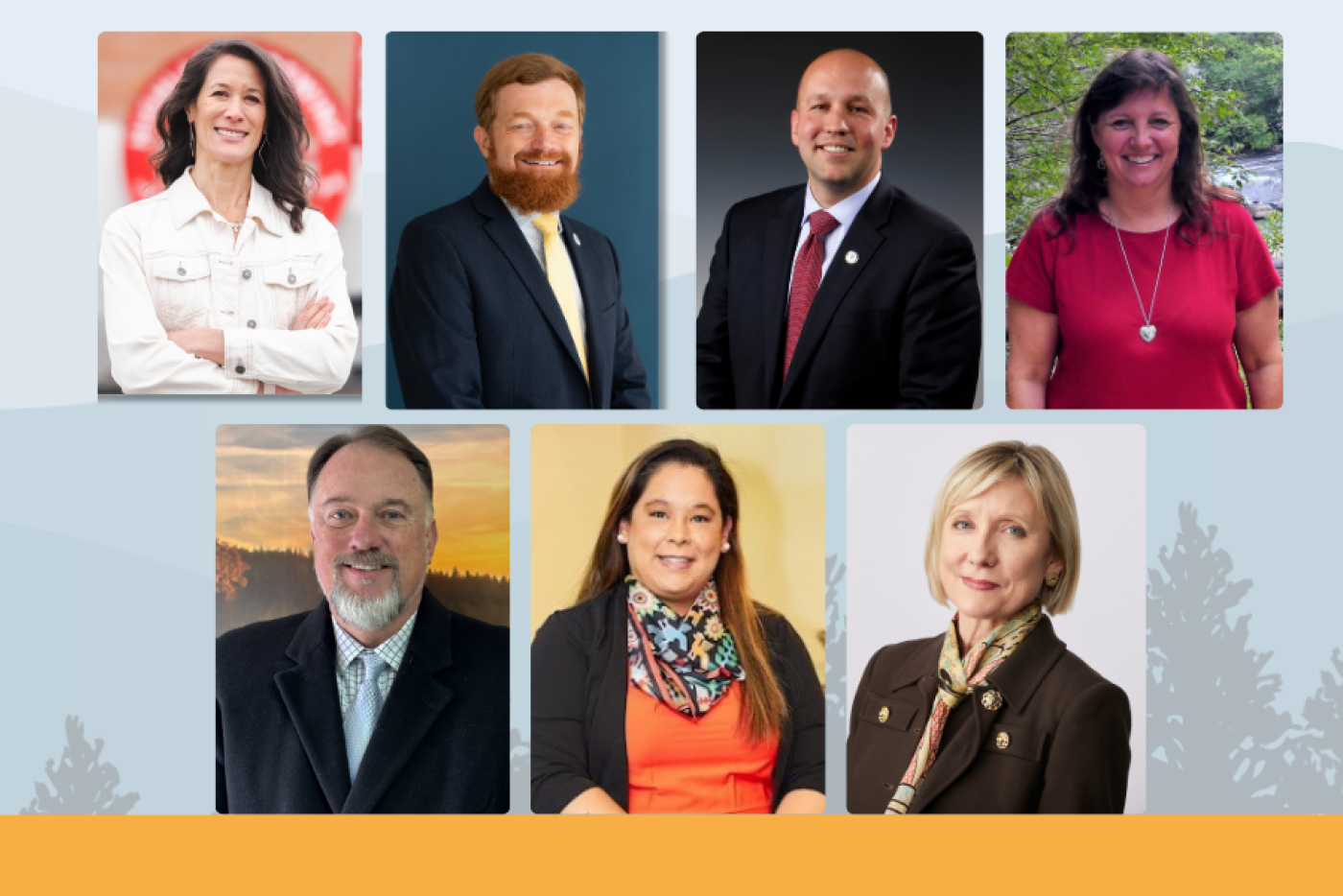
On January 2, 2026, Governor Josh Stein appointed seven new members to the Governor’s Advisory Committee on Western North Carolina Recovery. Each individual brings a unique geographic and professional perspective to the Advisory Committee, but all share a deep commitment to recovery in their communities and across the region. Read on to learn more about the new appointees, including their involvement in Hurricane Helene relief and recovery efforts.
Leah Wong Ashburn, President/CEO and Family Owner, Highland Brewing Co.
What role have you/your organization played in the aftermath of Hurricane Helene?
Highland was lucky to have an empty warehouse at the time, willing and capable staff, and much-needed equipment.
We turned our brewery campus into a community hub, housing eight organizations and becoming a public roadway for a neighborhood and a zoo whose two-story, two-lane, concrete bridge washed out. We invited the nonprofit organization BeLoved Asheville to move into our warehouse, which filled with resources. Highland staff drove forklifts, organized and moved supplies, directed traffic and trucks, and oversaw safety.
Among thousands of items were numerous pallets of raw chicken, diapers, batteries, dog food, cat litter, and gasoline, and seemingly innumerable pallets of bottled water, all under the 24/7 watch of North Carolina State Troopers, whose relief supplies were also stored in our warehouse.
Describe an issue or challenge you are eager to address through your work on this Advisory Committee.
I’d like to learn how we might better support the small business sector after a disaster. Small businesses are the economic engine of the community, with ripple effects and long-term benefit to staff who live here. I’m also interested in better understanding the insurance industry, which failed us and is of little value to businesses unless things change. Lastly, I’d like to learn how we could encourage faster movement on the federal side in financial support for disaster response.
Silvia Martin del Campo Vargas, LatinX Education Liaison, McDowell Technical Community College (MTCC)
What role have you/your organization played in the aftermath of Hurricane Helene?
I volunteered for seven consecutive days at the local Emergency Operations Center warehouse with my family – supporting logistics, food distribution, and volunteer coordination, including recruiting volunteers from surrounding areas. I traveled with a group of volunteers to assist families who were unable to leave their homes by delivering food and water while ensuring Spanish-speaking families could access needed assistance by providing translation and language support.
I also served on a multidisciplinary team to support small business owners through the Business & Industry Recovery Resource Center initiative created by MTCC, providing coordinated recovery resources to businesses impacted in McDowell County.
Describe one of the ways your city/town/county has made you proud during recovery from Hurricane Helene.
I was proud of how quickly leaders from across McDowell County came together to establish the Emergency Operations Center and ensure residents had access to basic needs. Equally inspiring was seeing neighbors help neighbors – delivering food, clearing trees, sharing meals, and offering power and support during a difficult time. This spirit has continued to unite our community as we collaborate towards a full recovery.
Melissa Patton, Executive Director, Carolina Land and Lakes RC&D
What role have you/your organization played in the aftermath of Hurricane Helene?
We hired an engineer to conduct an assessment of private roads, bridges, and culverts that insurance and FEMA were not paying for. We shared that information with NC Emergency Management to cross-reference with their database and to offer assistance with landowner outreach to get the work completed.
I joined the American Flood Coalition in their advocacy work in Raleigh and in Washington, D.C., to advocate with and for our local communities to gain the resources necessary to rebuild. The coalition succeeded in getting $20 million appropriated from the NC General Assembly to NC Emergency Management to be granted out to Helene-impacted counties.
Describe an issue or challenge you are eager to address through your work on this Advisory Committee.
One of our organization’s priorities – before Helene and post-hurricane – continues to be wildland fire mitigation. I am eager to address flood resilience and wildfire resilience in the region. WNC needs more resources dedicated to these efforts. In the rebuilding process, we must plan for the long term and what will make the region more resilient. There are not enough resources to educate homeowners about how to protect themselves and to assist them in mitigation efforts to reduce their risk of wildland fire. Our small towns need more resources for flood resilience when rebuilding. This committee has the opportunity to raise awareness and advocate for the resources our communities need.
David Jackson, President and CEO, Boone Area Chamber of Commerce
What role have you/your organization played in the aftermath of Hurricane Helene?
The Boone Area Chamber of Commerce Foundation (BACCF) raised and distributed over $1.3 million in small business disaster grants to businesses in Watauga, Ashe, and Avery counties. The organization also worked with a local business to create and staff an intake site for critical supplies for distribution throughout the region. The BACCF has also remained committed to supporting early childhood educators following the storm, raising $206,000 in emergency tuition assistance for parents with children in licensed centers in October 2024, providing stabilization to the industry, and allowing for the reallocation of critical financial support to local families before other help arrived.
Describe one of the ways your city/town/county has made you proud during recovery from Hurricane Helene.
The genuine cooperation shown between the Town of Boone, Town of Blowing Rock, Watauga County, and Appalachian State University during and after the storm has been nothing short of inspirational. These entities have been united on Helene relief efforts and routinely share information and best practices regarding the nuanced work of recovery. This experience brought these community partners back together in collaborative ways that will positively impact our community long beyond our current recovery work.
Chris Sigmon, Planner, Yancey County; Executive Director, Yancey County Long-Term Recovery Group (LTRG)
What role have you/your organization played in the aftermath of Hurricane Helene?
On September 29, 2024, I was asked by Yancey County to support the recovery effort as part of the command center team, a group of multidisciplinary organizations from around the country brought here to deal with the immediate aftermath.
Initially, I was asked to oversee all the donations pouring into the county. In this role, I negotiated 600,000 square feet of free warehouse space in Mitchell County and leased the old Fred’s retail space on the 19E bypass in Burnsville to facilitate a warehouse/grocery store model to store and distribute donations. We established an intake process for receiving donations into the warehouse and implemented a distribution system to deliver resources to point-of-use sites throughout the county. At our peak, we managed more than10,000 pallets of donated goods.
Yancey County Government approached me in November 2024 with a position as county planner to focus on countywide disaster recovery. The most notable aspects of the job were heading up the countywide debris removal program and the restoration of roads and bridges to allow for emergency access.
In April 2025, I was asked to run the Long-Term Recovery Groups of Yancey, Mitchell, and Avery Counties as the executive director. I accepted a part-time position as executive director for the Yancey LTRG and moved to part-time planner with Yancey County government. To date, the Yancey LTRG has raised more than $1.6 million in support of those impacted by Helene.
I remain deeply committed to a strong, equitable recovery and to building long-term resilience for the community I call home.
Todd McNeill, Executive Director, NC Association of Regional Councils of Government; Commissioner, Ashe County
What role have you/your organization played in the aftermath of Hurricane Helene?
My experience with Hurricane Helene began with a very personal, front-row view of the disaster, as my family lives along Helton Creek in one of the impacted communities. At the time, and continuing today, I serve on the Ashe County Board of Commissioners and was involved in the immediate response, working to support our emergency management team and responding agencies while staying closely connected to residents in the community.
Today, I work with North Carolina’s Regional Councils of Government, supporting local governments across the state as they navigate the complex landscape of FEMA and other state and federal recovery programs.
Describe one of the ways your city/town/county has made you proud during recovery from Hurricane Helene.
I am incredibly proud of the roles Regional Councils of Government (COG) are playing in recovery, especially in supporting smaller towns and counties that do not always have the staff capacity or technical expertise to manage complex recovery programs on their own. The hands-on support and coordination provided by COG staff help ensure these communities are not left behind. That work ultimately shows up in real, meaningful recovery outcomes for the citizens who call these places home.
Rose Vaughn Williams, Executive Director, NC League of Municipalities
What role have you/your organization played in the aftermath of Hurricane Helene?
I’m so proud of the direct technical assistance and expertise the League has been able to provide our members – our dedicated disaster recovery employees have sat with members in their towns and worked to connect them with the information and expert partners they have needed. We have visited more than 80 towns across western North Carolina, hosted seven informative webinars, and had more than 1,500 direct interactions to help with navigating FEMA requirements, grant writing and grant management projects, catch-up accounting, cybersecurity assistance, and more.
We also co-hosted several convenings in western North Carolina with the Western Regional Councils of Government and the NC Association of County Commissioners to bring our members together so they could identify immediate and longer-term recovery needs, hear directly from state and federal officials about funding, and share their stories with those policymakers to ensure their needs were heard in the weeks immediately following the storm.
Describe one of the ways your city/town/county has made you proud during recovery from Hurricane Helene.
It was heartening to see our members – countless cities towns across the state (100+) – come together to share their resources in the wake of Helene. The response for mutual aid was almost instantaneous with emergency responders, firefighters, police officers, utility workers, public information officers, and others, deployed to WNC to search for residents, clear debris, fix water and power lines, and more. We saw mutual aid provided from our largest cities and smallest towns with no hesitation. The strong bonds between our municipalities were on full display.
Coming Up
The next meeting of the Advisory Committee will be held virtually on Monday, Feb. 9, 2026. Meetings are open to public attendance. Time for public comment will not be available, but feedback can be sent by email to wncrecovery@nc.gov. Visit the GROW NC website to find meeting materials and a link to register to attend the meeting.